How To write Resume objective desirable for HR in MNCS company like TCS, Wipro, HCL, microsoft etc?
Employers and recruiters review hundreds of resumes every day.
Therefore, writing a resume that stands out from the crowd is a key success factor for job seekers. An eye-catching resume will increase your chances of getting a job interview.
Writing a resume is challenging. You have to work hard on every phrase to effectively describe your achievements, skills, strengths and most importantly your resume objectives statement.
This article offers sample objectives for resumes and describes the importance of resume objectives with many examples.
What is a Good Objective for a Resume?
 What is a resume objective statement and why is it so important?
The resume objectives statements are a short summary of your profile and your career goals and it is what employers are looking for.
In other words, the objectives are for the employers so they can evaluate your competencies. The resume objectives help them perceive whether you would suit the position.
Employers tend to search for phrases and basic qualities that fit the job position. That is why you may place the resume objective paragraph at the beginning.
You also want to be brief and to the point to increase the chances that your resume will be read and chosen/selected.
Your career summary may be part of the resume objectives paragraph, that is if you have years of professional experience.
Therefore, the resume objectives should be divided into two elements -
1. Your career summary (i.e. professional history)
2. Resume objectives: description of the job that you are seeking.
Let’s start with #2 – the resume objective statement examples.
3. “Sales manager position where my skills and experience can be effectively utilized for increased profitability and product sales volume by developing a dynamic team.”
4. “Seeking a project management position with leadership responsibilities including problem solving, planning, organizing and managing budgets.”
5. “Seeking a position in an office environment, where there is a need for a variety of office management tasks including – computer knowledge, organizational abilities, business intelligence and database program use.”
6. “Obtain a position as a team-player in a people-oriented organization where I can maximize my customer-service experience in a challenging environment to achieve the corporate goals.”
7. “To obtain a position as a School Teacher that will utilize my strong dedication to children’s development and to their educational needs.”
8. “To obtain a position as an office Secretary in which my computer knowledge, and organizational abilities can be fully utilized.”
9. “To obtain a position as a software program designer in a challenging environment that utilizes team-work effort for researching, learning and developing new high-tech products. “
10. “Customer care representative position where my customer relations experience can be fully utilized to improve customer satisfaction and enhance the company brand name.”
11. “Create business strategies and develop existing customer sales, marketing tools and product launching.”
12. “To obtain a human resources management position where I can effectively utilize my expertise in employee relations and staff recruitment.”
13. “Product Marketing position that utilizes my marketing experience and enables me to make a positive contribution to the company.”
14. “To secure a position that will lead to a lasting working relationship in the field of accounting or bookkeeping.”
15. “To obtain a position that will enable me to use my strong organizational skills, educational background and ability to work well with people.”
1. “As a fully qualified headteacher with 15 years of varied experience, there’s much I can offer to the education of our young children. I have more than 10 years of experience in mentoring and coaching teaching staff in ABC school. I’m confident that my passion for the teachers’ and children’s development, together with my skills and experience will enable me to make a significant difference at your school.”
2. “I am a PhD business management professional with more than 16 years of experience. I possess multiple skills covering many fields including – business development, organization management and marketing enhancement. I have been a managing director where I led a marketing division of 2000 marketing engineers across 3 countries. I have a long list of corporate achievements that I would be pleased to present.”
Career Objectives examples for Resumes
Resume: Keywords for Resumes
1. “As a fully qualified headteacher with 15 years of varied experience, there’s much I can offer to the education of our young children. I have more than 10 years of experience in mentoring and coaching teaching staff in ABC school. I’m confident that my passion for the teachers’ and children’s development, together with my skills and experience will enable me to make a significant difference at your school.”
2. “I am a PhD business management professional with more than 16 years of experience. I possess multiple skills covering many fields including – business development, organization management and marketing enhancement. I have been a managing director where I led a marketing division of 2000 marketing engineers across 3 countries. I have a long list of corporate achievements that I would be pleased to present.”
Learn how to use resume samples or templates to help construct your resume.
Your resume is what gets you the interview or keeps you from getting an interview.
It deserves your undivided attention. You can maximize the effect of your resume by learning how to use resume samples or templates to help construct your resume.
You need to assume in this tough economic that there are going at least a handful of other applicants with the same or better skills and experience than you have.
Employers can demand a lot from their applicants, and those demands begin with the resume.
1. Select a Template to Customize
A resume sample or template can be really beneficial if you need to create a new resume or rewrite your resume. It’s a great way to get some ideas and to find a starting point to begin to create your resume. You can add your information to the resume template and then edit to personalize the information so that it is your information.
Once you have replaced sample information with your resume information, it’s time to begin to tweak your resume to get the most out of it.
2. Make a comparison
Of course, there are other ways to use sample resumes. You can compare your resume to the sample. You can see where you have done things differently, and decide whether you can benefit from making changes that reflect what the sample is showing.
3. Format to use
You can discover all kinds of resume formatting tips that can polish you resume. There’s a difference between putting your resume together and giving it those final touches that make it stand out in the pile.
For example, let’s say that you resume along with six other resumes that are almost identical to yours are pulled out of the pile. What will make your resume be chosen over another person’s resume will come down to the appearance of the resume. The resume that is most polished is more than likely the one that will chosen for the interview process.
4. Make it Unique
A unique resume is also far more likely to get noticed than one that looks like every other resume. Translated – this means don’t just take a sample resume and copy the entire thing simply replacing your information with the sample information, because that’s exactly how half of the resumes in the pile will be put together. Your resume won’t stand out, it won’t get noticed.
Summary: the resume is a picture of yourself
Your resume is like a picture of who you are, and it goes beyond your skills and experience.
Think of it this way. Let’s say you make it to the interview stage and you have all the experience, and skills they want, but you show dressed sloppily, you are unorganized, you are wearing too much perfume or cologne, and your overall impression is poor.
Candidate B shows with a little less experience and skills but is well polished; put together, dressed professionally, and makes a good first impression. Candidate B is much more likely to be hired.
This same analogy applies to your resume.
Information gathering in the resume :What to Include or Skip Out?????
Today, thanks to the internet, there are hundreds of free examples you can look at. You can use information from these free examples to construct a highly effective resume. Make your draft, copy and paste phrases such as good achievements, key job duties, objectives, and key skills.
The table format is a very popular format. There may be more headings but take up less space. It’s one of the popular formats. Another popular format is the outline format that uses margins and tabs rather than tables. It is an easier format to control, and it can be easily converted to a file that can be scanned.
By reviewing a number of different resumes, you will get ideas that you could use in your resume. Then you can begin to define how you want your resume to look, and what’s important for the job position you are applying for. You should never take the attitude that one resume style fits all, because it doesn’t.
Creating Your Own Resume Style
Rather than using a template, it is often better to take ideas from a template, and create your very own resume style.
There are a number of resume styles you can use. Choose the style that best suits you, your experience, your skills, and the position you are applying for.
What type of resume style is best for you? Look at the different styles below.
There are a number of resume types used when applying for a job posting. The right resume type will depend on your personal circumstance.
1. Chronological Resume
A chronological resume begins with your work history, starting with the most recent position. Post your jobs in reverse chronological order beginning with your current job or your most recent job. Employers like this type of resume because it is easy to see where you’ve worked and what positions you have held. It is best used by those with a solid work history.
2. Functional Resume
A functional resume focuses on your experience and your skills, rather than focusing on your chronological work history. This resume format is best for those who are changing careers or for anyone who has gaps in their work history.
3. Combination Resume
A combination resume begins with your experience and skills, followed by the employment history. This type of resume highlights skills relevant to the position you are applying for, while at the same time providing the chronologic work history that employees like.
4. Targeted Resume
A targeted resume is a customized resume that focuses on the skills and experience relevant to the position you are applying for. This type of resume requires more work, but it is worth the effort because it is so focused it is likely to get noticed.
5. Mini Resume
A mini resume has a brief summary of your career qualifications, and it is good for networking or prospective employers who don’t currently have a job posting. It’s a great way to provide an overview.
Don’t underestimate the power of it, as this is the first introduction of you to any prospective employer. Think of your resume as a portrait of who you are.
Make sure you recognize just how powerful tool your resume is and treat it as such. While the easy definition might be that a resume is a written document that details an individual’s experience, skills, and background, it is some much more than words on paper.
Think of your resume as your calling card and treat it as such.
In this economy, it is more important than ever. Employers see thousands of resumes and after awhile they can tend to blur together unless there’s something that catches the attention of the hiring manager. The number of resumes a hiring manager sees for any given job posting can be overwhelming. Consider this – what will make your resume noticeable so that he/she doesn’t just flip past it. If you are serious about getting the job, you will make sure you create a resume that gets you noticed.
More things to consider:
What should you include on your resume? Do you need to include an objective? Will you include a career summary? Are you going to add your references? Will you include your hobbies?
When creating your resume it is not the time to be modest. While your resume should not lie or exaggerate, it should also not understate your experience and your skills.
In addition to presenting your skills and experience, how you layout your resume, and what you include on your resume can help your resume get noticed to the hiring manager. Like a fine artist takes the time to create the perfect brush strokes, so should you when it comes to creating the perfect resume. Works of art get noticed.
Make your resume that work of art!
what mistakes to avoid in resume writing in your resume? -Wrong Phrases or opt writing ...
You put all that energy into creating the perfect resume, and then you don’t even receive a call for an interview.
It seems to happen over and over, and that leaves you scratching your head about what went wrong.
Let’s look at resume phrases that are overworked and will kill your resume.
Top 6 Words That Will Get Your Resume Tossed
For example, rather than saying you are a good communicator, be specific about the communication skills you have and how you have used them effectively.
While we’ll admit not every resume will be rejected because of these phrases, the majority will land up on the reject pile faster than the average resume.
You should put a little creativity into the creation of your resume. Remember, your resume is an advertisement about your skills and experience. Just as a boring advertisement doesn’t get much attention, neither does a boring resume – you know the one – it looks like everyone else’s resume.
After awhile, the phrases all begin to blend together.
Instead of doing what everybody else is doing, break free and get a little more creative.
“I am a marketing researcher driven by my own curiosity about what makes people do what they do and buy what they buy. At ABC Industries, I constructed online forums and consumer surveys, to uncover the buying habits of the consumer and why our products were chosen over the competitions. As a result over the following year our sales grew by 35%.”
When you create your human voice resume you want to make sure that it is clear and concise, and that you do not find yourself telling a story. Interviewers are busy people, and they don’t have time to read your book.
You must respect the interviewers time and not be too wordy or your resume is likely to make it to the “no” pile very quickly.
List of skills for Resume Every company would like to find the best employee for each position based on a specific set of necessary professional skills.
Fortunately, most job seekers possess these job skills in one way or another.
Employers characterize candidates based on list of skills and strengths/weaknesses.
Therefore, as a job seeker, one has to prepare his job-search communication tools based on the language used by employer -
The communication tools are – Your resume, cover letter and your job interview verbal communications.
This article suggests sample list of required job professional skills for resumes. You may edit the list and include/put some skills in your resume according to your needs.
The table is divided to major professions with suggested skills to list on resume:
• Strong verbal and personal communication skills.
• Accuracy and Attention to details.
• Organization and prioritization skills.
• Problem analysis, use of judgment and ability to solve problems efficiently.
Example of another Specialized Skills
Verbal and written communication, client & partner relationship management, business development, high touch customer service, attention to detail & organized, self-sufficient & proactive, client & partner hospitality, professional public speaking & presentation experience, ability to successfully training others.
• Self motivated, initiative, high level of energy.
• Verbal communication skills.
• Decision making, critical thinking, organizing and planning.
• Tolerant and flexible to different situations.
Other skills -
• Leadership communication skills
• Business leadership skills
• Technical and technological skills
• Organizational skills
• Project management skills
• Key sales and marketing skills
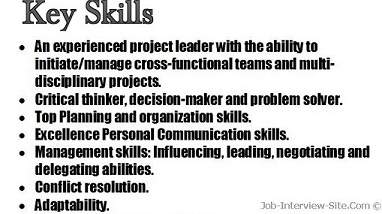
• An experienced team leader with the ability to initiate/manage cross-functional teams and multi-disciplinary projects.
• Critical thinking, decision-making and problem solving skills.
• Planning and organizing.
• Excellence Personal Communication skills.
• Project management skills: Influencing, leading, negotiating and delegating abilities.
• Conflict resolution.
• Adaptability.
• Tolerant to stressed situations.
Key Skills for Teachers
• Self motivated
• Initiative with a high level of energy.
• Strong verbal and personal communication skills.
• Decision making, critical thinking, organizing and planning
• Tolerant and flexible to different situations.
Key Skills for Accounting
• Analytical thinking, planning.
• Accuracy and Attention to details.
• Organization and prioritization skills.
• Problem analysis, use of judgment and ability to solve problems efficiently.
Key Skills for Customer Service
• Strong communication skills
• Problem analysis and problem solving
• Organizational skills and customer service orientation
• Adaptability and ability to work under pressure
• Initiator
 You may also be interested in reading the articles:
Employers and recruiters review hundreds of resumes every day.
Therefore, writing a resume that stands out from the crowd is a key success factor for job seekers. An eye-catching resume will increase your chances of getting a job interview.
Writing a resume is challenging. You have to work hard on every phrase to effectively describe your achievements, skills, strengths and most importantly your resume objectives statement.
This article offers sample objectives for resumes and describes the importance of resume objectives with many examples.
What is a Good Objective for a Resume?
The resume objectives statements are a short summary of your profile and your career goals and it is what employers are looking for.
In other words, the objectives are for the employers so they can evaluate your competencies. The resume objectives help them perceive whether you would suit the position.
Employers tend to search for phrases and basic qualities that fit the job position. That is why you may place the resume objective paragraph at the beginning.
You also want to be brief and to the point to increase the chances that your resume will be read and chosen/selected.
Your career summary may be part of the resume objectives paragraph, that is if you have years of professional experience.
Therefore, the resume objectives should be divided into two elements -
1. Your career summary (i.e. professional history)
2. Resume objectives: description of the job that you are seeking.
Let’s start with #2 – the resume objective statement examples.
Resume Objective Examples
Here are objective statements that you can rewrite/edit and use for your resume
1. “Obtain a position at ABC institute where I can maximize my training experience, program development skills and my teaching abilities.“ 2. “Seeking a position that will benefit from my sales experience, positive interaction skills and industry contacts where my twelve years’ experience can improve the sales results.”3. “Sales manager position where my skills and experience can be effectively utilized for increased profitability and product sales volume by developing a dynamic team.”
4. “Seeking a project management position with leadership responsibilities including problem solving, planning, organizing and managing budgets.”
5. “Seeking a position in an office environment, where there is a need for a variety of office management tasks including – computer knowledge, organizational abilities, business intelligence and database program use.”
6. “Obtain a position as a team-player in a people-oriented organization where I can maximize my customer-service experience in a challenging environment to achieve the corporate goals.”
7. “To obtain a position as a School Teacher that will utilize my strong dedication to children’s development and to their educational needs.”
8. “To obtain a position as an office Secretary in which my computer knowledge, and organizational abilities can be fully utilized.”
9. “To obtain a position as a software program designer in a challenging environment that utilizes team-work effort for researching, learning and developing new high-tech products. “
10. “Customer care representative position where my customer relations experience can be fully utilized to improve customer satisfaction and enhance the company brand name.”
11. “Create business strategies and develop existing customer sales, marketing tools and product launching.”
12. “To obtain a human resources management position where I can effectively utilize my expertise in employee relations and staff recruitment.”
13. “Product Marketing position that utilizes my marketing experience and enables me to make a positive contribution to the company.”
14. “To secure a position that will lead to a lasting working relationship in the field of accounting or bookkeeping.”
15. “To obtain a position that will enable me to use my strong organizational skills, educational background and ability to work well with people.”
Career Summary – Examples for Resume Objectives Paragraphs
Here are two examples for a career summary:1. “As a fully qualified headteacher with 15 years of varied experience, there’s much I can offer to the education of our young children. I have more than 10 years of experience in mentoring and coaching teaching staff in ABC school. I’m confident that my passion for the teachers’ and children’s development, together with my skills and experience will enable me to make a significant difference at your school.”
2. “I am a PhD business management professional with more than 16 years of experience. I possess multiple skills covering many fields including – business development, organization management and marketing enhancement. I have been a managing director where I led a marketing division of 2000 marketing engineers across 3 countries. I have a long list of corporate achievements that I would be pleased to present.”
Career Objectives examples for Resumes
Resume: Keywords for Resumes
Perhaps you’d be surprise to know that your resume is not screened by
human being but by software before it gets to the human resources.
How should you write your resume to get it found in a crowded resumes database?
This article reviews the usage of keywords in resumes and provides the key tips on how to find and insert keywords into resumes.
Keyword is a specific word or a phrase which occurs in a text document.
Keyword is a term – this term is generally used to specify a single word or a phrase. Phrase is a combination of several words, sometimes a short sentence.
You may also stumble upon the term key-phrase (for key phrases), or key term, but these are not in use as often as the term “keyword”.
What is a resume keyword?
Because of the vast amount of resumes that every human resources compress in their database, most of these HR work with an electronically tool to scan and screen these resume when they look for potential applicants.
This tool is called Resume Scanner Software or Recruiting Management Software.
This scanner will pick your resume up based on the keywords (or key terms) used in it.
Should you use keywords in a resume?
Certainly you should.
Needless to say, that if you want that your resume gets found, being a good match for a position, you should write it using specific keywords.
How to find keywords for a resume?
The keywords to target are those that are used in:
• The general job description (i.e. job requirement): of the jobs that you are interested in. You can look to any job posting, relevant to your job hunting target, and screen out the keywords, such as – professional expertise, technology skills, education, years of experience/education, some action words and relevant competencies.
Secondly, look for keywords such as:
• University Certifications and the name of the educational institution
• Job Titles , professional expertise
• Product Names, Service type, Technical/Industry terms,
• Software or Hardware areas
• Job Search Engines: the internet is full of web search engines that provide job listings. Google these search engines and you will find combination of job titles and professional expertise for each job that you are looking for.
Where to insert the keywords into your resume?
There are four places to aim to – resume objectives, education, professional courses and resume career summary.
These paragraphs are the most important parts of your resume.
• Sales, Marketing, Sales Manager, Marketing manager, Retail
• Product Manager, Project Manager, System Architect
• Account Executive, Manager, Director
• Business Intelligence, Business development
• Medical Sales, Medical Device
• Healthcare, Medical, Nurse, Physician, Therapist
• Finance, Accounting, Bank, banking, TAX, insurance
• Financial Advisor, Business Analyst
• Supervisor, Controller
• IT, CISCO, SAP, JAVA, ORACLE, ERP, BI, C++
• Ethernet & IP Networking, ATM, MPLS, IPMPLS, Carrier Ethernet, Metro Ethernet
• Wireless, VoIP, Triple play, IPTV & VOD
• Operations, Supply Chain, Logistics, Manufacturing, Packaging
• CEO, CFO, VP
• Human Resources, Recruiting
• Software, Programmer, Engineer, Specialist, Analyst, Administrator, Consultant, Architect, Development, Designer, Technicians
How should you write your resume to get it found in a crowded resumes database?
This article reviews the usage of keywords in resumes and provides the key tips on how to find and insert keywords into resumes.
Keywords in Resumes
What is a keyword?Keyword is a specific word or a phrase which occurs in a text document.
Keyword is a term – this term is generally used to specify a single word or a phrase. Phrase is a combination of several words, sometimes a short sentence.
You may also stumble upon the term key-phrase (for key phrases), or key term, but these are not in use as often as the term “keyword”.
What is a resume keyword?
Because of the vast amount of resumes that every human resources compress in their database, most of these HR work with an electronically tool to scan and screen these resume when they look for potential applicants.
This tool is called Resume Scanner Software or Recruiting Management Software.
This scanner will pick your resume up based on the keywords (or key terms) used in it.
Should you use keywords in a resume?
Certainly you should.
Needless to say, that if you want that your resume gets found, being a good match for a position, you should write it using specific keywords.
How to find keywords for a resume?
The keywords to target are those that are used in:
• The general job description (i.e. job requirement): of the jobs that you are interested in. You can look to any job posting, relevant to your job hunting target, and screen out the keywords, such as – professional expertise, technology skills, education, years of experience/education, some action words and relevant competencies.
Secondly, look for keywords such as:
• University Certifications and the name of the educational institution
• Job Titles , professional expertise
• Product Names, Service type, Technical/Industry terms,
• Software or Hardware areas
• Job Search Engines: the internet is full of web search engines that provide job listings. Google these search engines and you will find combination of job titles and professional expertise for each job that you are looking for.
Where to insert the keywords into your resume?
There are four places to aim to – resume objectives, education, professional courses and resume career summary.
These paragraphs are the most important parts of your resume.
Resume Keywords: List of Keywords for Resumes
Here is a list of keywords for resumes as an example:• Sales, Marketing, Sales Manager, Marketing manager, Retail
• Product Manager, Project Manager, System Architect
• Account Executive, Manager, Director
• Business Intelligence, Business development
• Medical Sales, Medical Device
• Healthcare, Medical, Nurse, Physician, Therapist
• Finance, Accounting, Bank, banking, TAX, insurance
• Financial Advisor, Business Analyst
• Supervisor, Controller
• IT, CISCO, SAP, JAVA, ORACLE, ERP, BI, C++
• Ethernet & IP Networking, ATM, MPLS, IPMPLS, Carrier Ethernet, Metro Ethernet
• Wireless, VoIP, Triple play, IPTV & VOD
• Operations, Supply Chain, Logistics, Manufacturing, Packaging
• CEO, CFO, VP
• Human Resources, Recruiting
• Software, Programmer, Engineer, Specialist, Analyst, Administrator, Consultant, Architect, Development, Designer, Technicians
Career Summary – Examples for Resume Objectives Paragraphs
Here are two examples for a career summary:1. “As a fully qualified headteacher with 15 years of varied experience, there’s much I can offer to the education of our young children. I have more than 10 years of experience in mentoring and coaching teaching staff in ABC school. I’m confident that my passion for the teachers’ and children’s development, together with my skills and experience will enable me to make a significant difference at your school.”
2. “I am a PhD business management professional with more than 16 years of experience. I possess multiple skills covering many fields including – business development, organization management and marketing enhancement. I have been a managing director where I led a marketing division of 2000 marketing engineers across 3 countries. I have a long list of corporate achievements that I would be pleased to present.”
Learn how to use resume samples or templates to help construct your resume.
Your resume is what gets you the interview or keeps you from getting an interview.
It deserves your undivided attention. You can maximize the effect of your resume by learning how to use resume samples or templates to help construct your resume.
You need to assume in this tough economic that there are going at least a handful of other applicants with the same or better skills and experience than you have.
Employers can demand a lot from their applicants, and those demands begin with the resume.
1. Select a Template to Customize
A resume sample or template can be really beneficial if you need to create a new resume or rewrite your resume. It’s a great way to get some ideas and to find a starting point to begin to create your resume. You can add your information to the resume template and then edit to personalize the information so that it is your information.
Once you have replaced sample information with your resume information, it’s time to begin to tweak your resume to get the most out of it.
2. Make a comparison
Of course, there are other ways to use sample resumes. You can compare your resume to the sample. You can see where you have done things differently, and decide whether you can benefit from making changes that reflect what the sample is showing.
3. Format to use
You can discover all kinds of resume formatting tips that can polish you resume. There’s a difference between putting your resume together and giving it those final touches that make it stand out in the pile.
For example, let’s say that you resume along with six other resumes that are almost identical to yours are pulled out of the pile. What will make your resume be chosen over another person’s resume will come down to the appearance of the resume. The resume that is most polished is more than likely the one that will chosen for the interview process.
4. Make it Unique
A unique resume is also far more likely to get noticed than one that looks like every other resume. Translated – this means don’t just take a sample resume and copy the entire thing simply replacing your information with the sample information, because that’s exactly how half of the resumes in the pile will be put together. Your resume won’t stand out, it won’t get noticed.
Summary: the resume is a picture of yourself
Your resume is like a picture of who you are, and it goes beyond your skills and experience.
Think of it this way. Let’s say you make it to the interview stage and you have all the experience, and skills they want, but you show dressed sloppily, you are unorganized, you are wearing too much perfume or cologne, and your overall impression is poor.
Candidate B shows with a little less experience and skills but is well polished; put together, dressed professionally, and makes a good first impression. Candidate B is much more likely to be hired.
This same analogy applies to your resume.
Information gathering in the resume :What to Include or Skip Out?????
Your resume is the first meeting a potential employer will have with you.
In these economic times when hiring managers see hundreds of resumes for every position, you want to make sure your resume has the chance to move forwards.
Let’s look at what you should include in a resume and what you should leave out.
Your resume should always include the following sections:
In these economic times when hiring managers see hundreds of resumes for every position, you want to make sure your resume has the chance to move forwards.
Let’s look at what you should include in a resume and what you should leave out.
Your resume should always include the following sections:
- Contact information – name, address, phone number, email address, web page
- Objective – your resume objective states your employment goals, and it is usually at the top of your resume.
- Work experience – this is a listing of the positions you have held, and the skills and experience associated with those positions. The order they appear on your resume will depend on the style of resume.
- Education – this is the listing of all your formal education including degrees earned, and individual course s you may have taken. Do not include your high school if you’ve gone on to earn a certificate, diploma, or degree.
- Computer skills/language skills – some positions require specific computer skills, others may not but having those additional skills on your resume could work to your benefit. The same applies if you speak more than one language; make sure to include it on your resume.
Resume Styles
There are several different resume styles. Let’s look at the most common ones resume formats- Chronological Resume Format – this is a good format when the time you’ve spent at a job is seen as strengths, and you want to show your advancements, including our job titles. A chronological resume will include a list of your work history starting with your most current.
- Functional Resume Format – This is a good choice for your resume if you are changing careers and need to identify your existing skills that may be useful. It is the right choice if, you have limited work experience in the field but you have skills that are applicable. This format focuses on highlighting your skills.
- Combination Resume Format – This resume format combines strengths from both the chronological resume and the functional resume.0
What You Should Never Include on Your Resume
Just as there are things that every resume should have, there are things that every resume should not have. Including any of these on your resume puts you at risk for not being called back.- Every job you’ve had since high school
- Any job experience that is irrelevant to the position you are applying for
- Any health issues
- Information about your family
- Lies about your experience or your education
- Your age and your social security number
- Poor grammar
- Your sexual preference, religion, and political identity
- Your physical characteristics
Four Top Resume Guidelines
1. Construct Your Resume Using Free Resume Examples
You can construct your resume using one of the examples you like.Today, thanks to the internet, there are hundreds of free examples you can look at. You can use information from these free examples to construct a highly effective resume. Make your draft, copy and paste phrases such as good achievements, key job duties, objectives, and key skills.
2. Resume Formats
There are different formats you can incorporate into your resume.The table format is a very popular format. There may be more headings but take up less space. It’s one of the popular formats. Another popular format is the outline format that uses margins and tabs rather than tables. It is an easier format to control, and it can be easily converted to a file that can be scanned.
3. How to Choose a Resume Template
How to choose a resume template?- Beware of the hidden file property information – If you are going to submit your file electronically, you need to make sure that the file property is searchable in the database.
- Avoid unique styles and formats – Stay away from anything that is too unique and indicates you have used a template. Employers want you to at least have enough motivation to create your own resume, which is why your resume needs to look like you put it together all by yourself.
- Make sure the resume format allows for scanning – Some templates incorporate underlying and italics. Both of these can cause problems with scanned files, so avoid.
4. Look at Different Styles and Formats Before Writing a Resume
Before undertaking the task of writing a resume, it is a good idea for you to take a little time to look at the different styles, and formats that can be used.By reviewing a number of different resumes, you will get ideas that you could use in your resume. Then you can begin to define how you want your resume to look, and what’s important for the job position you are applying for. You should never take the attitude that one resume style fits all, because it doesn’t.
Creating Your Own Resume Style
Rather than using a template, it is often better to take ideas from a template, and create your very own resume style.
There are a number of resume styles you can use. Choose the style that best suits you, your experience, your skills, and the position you are applying for.
What type of resume style is best for you? Look at the different styles below.
There are a number of resume types used when applying for a job posting. The right resume type will depend on your personal circumstance.
1. Chronological Resume
A chronological resume begins with your work history, starting with the most recent position. Post your jobs in reverse chronological order beginning with your current job or your most recent job. Employers like this type of resume because it is easy to see where you’ve worked and what positions you have held. It is best used by those with a solid work history.
2. Functional Resume
A functional resume focuses on your experience and your skills, rather than focusing on your chronological work history. This resume format is best for those who are changing careers or for anyone who has gaps in their work history.
3. Combination Resume
A combination resume begins with your experience and skills, followed by the employment history. This type of resume highlights skills relevant to the position you are applying for, while at the same time providing the chronologic work history that employees like.
4. Targeted Resume
A targeted resume is a customized resume that focuses on the skills and experience relevant to the position you are applying for. This type of resume requires more work, but it is worth the effort because it is so focused it is likely to get noticed.
5. Mini Resume
A mini resume has a brief summary of your career qualifications, and it is good for networking or prospective employers who don’t currently have a job posting. It’s a great way to provide an overview.
Make Your Resume Work Harder For You
1. A resume could make or break getting a job
Effective resume is a strategic resume.Don’t underestimate the power of it, as this is the first introduction of you to any prospective employer. Think of your resume as a portrait of who you are.
Make sure you recognize just how powerful tool your resume is and treat it as such. While the easy definition might be that a resume is a written document that details an individual’s experience, skills, and background, it is some much more than words on paper.
Think of your resume as your calling card and treat it as such.
2. How Important is a Well Constructed Resume
You need to make sure you give your resume the attention it deserves so that you create an effective resume.In this economy, it is more important than ever. Employers see thousands of resumes and after awhile they can tend to blur together unless there’s something that catches the attention of the hiring manager. The number of resumes a hiring manager sees for any given job posting can be overwhelming. Consider this – what will make your resume noticeable so that he/she doesn’t just flip past it. If you are serious about getting the job, you will make sure you create a resume that gets you noticed.
3. What to Add or Leave Out of Your Resume
There seems to be an ongoing debate over what to add to a resume and what to leave out when it comes to hobbies, awards, volunteering, etc. There are different opinions on this part of the resume; however, the general consensus is to avoid including irrelevant commentary. Hiring managers are busy and they want to get straight to the point.More things to consider:
What should you include on your resume? Do you need to include an objective? Will you include a career summary? Are you going to add your references? Will you include your hobbies?
- It would be nice if there was a simple answer to these questions, but the truth is it will depend on the position you are applying for. You should access every job position, and every company, you are applying to, and then decide what it is you should include.
- Needless to say that, you should not include in your resume any information that is irrelevant, or that the hiring manager doesn’t need to see. Do include all information that the hiring manager needs to know about your skills and experience. When in doubt leave it out.
4. How to Make Your Resume Work for You
Your resume needs to paint a picture of who you are, and what it is you can offer the company that is seeking to fill a job posting.When creating your resume it is not the time to be modest. While your resume should not lie or exaggerate, it should also not understate your experience and your skills.
In addition to presenting your skills and experience, how you layout your resume, and what you include on your resume can help your resume get noticed to the hiring manager. Like a fine artist takes the time to create the perfect brush strokes, so should you when it comes to creating the perfect resume. Works of art get noticed.
Make your resume that work of art!
what mistakes to avoid in resume writing in your resume? -Wrong Phrases or opt writing ...
You put all that energy into creating the perfect resume, and then you don’t even receive a call for an interview.
It seems to happen over and over, and that leaves you scratching your head about what went wrong.
Let’s look at resume phrases that are overworked and will kill your resume.
Top 6 Words That Will Get Your Resume Tossed
- Responsible for…. (I.e. Responsible for closing cash)
- Experience in … (I.e. Experience in using Microsoft Word)
- Excellent written communication skills
- Team Player
- Detail orientated
- Successful (I.e. Successfully sold products)
- Results-oriented professional
- More than [x] years of progressively responsible experience
- Strong work ethic
- Meet or exceeded expectations
- Excellent communication skills
- Proven track record of success
- Works well with all levels of staff
- Cross-functional teams
- Bottom-line orientation
- Visionary
- Strategic thinker
- Proven track record
- Problem solver
- Goal orientated
- Multi-tasker
- Seasoned professional
- Dedicated professional
- Technically savvy
- Detail orientated
- They don’t say anything. They are simply fillers.
- They are boring and unoriginal
- They are self praising
- They are tacky
- They are not factual
- They cannot be proven
For example, rather than saying you are a good communicator, be specific about the communication skills you have and how you have used them effectively.
While we’ll admit not every resume will be rejected because of these phrases, the majority will land up on the reject pile faster than the average resume.
You should put a little creativity into the creation of your resume. Remember, your resume is an advertisement about your skills and experience. Just as a boring advertisement doesn’t get much attention, neither does a boring resume – you know the one – it looks like everyone else’s resume.
After awhile, the phrases all begin to blend together.
How to Transpose the Human Voice into Your Resume
Giving your resume a human voice will go much farther than using the wrong phrases.Instead of doing what everybody else is doing, break free and get a little more creative.
“I am a marketing researcher driven by my own curiosity about what makes people do what they do and buy what they buy. At ABC Industries, I constructed online forums and consumer surveys, to uncover the buying habits of the consumer and why our products were chosen over the competitions. As a result over the following year our sales grew by 35%.”
When you create your human voice resume you want to make sure that it is clear and concise, and that you do not find yourself telling a story. Interviewers are busy people, and they don’t have time to read your book.
You must respect the interviewers time and not be too wordy or your resume is likely to make it to the “no” pile very quickly.
List of skills for Resume Every company would like to find the best employee for each position based on a specific set of necessary professional skills.
Fortunately, most job seekers possess these job skills in one way or another.
Employers characterize candidates based on list of skills and strengths/weaknesses.
Therefore, as a job seeker, one has to prepare his job-search communication tools based on the language used by employer -
The communication tools are – Your resume, cover letter and your job interview verbal communications.
Resume: Skills Section of Resume
You may want to present your competency and how your background is tailored to the said job in the best way you can.This article suggests sample list of required job professional skills for resumes. You may edit the list and include/put some skills in your resume according to your needs.
CV skills Samples: Examples of Job Skills to List on a Resume
The following are examples of professional skills that you may list in your resume.The table is divided to major professions with suggested skills to list on resume:
| Skills and abilities | Managers Leaders |
Sales & Marketing, Customer Service |
Programmers Designers R&D, Teachers |
| Time management skills | Yes | Yes | |
| People management skills | Yes | ||
| interpersonal communication skills | Yes | Yes | |
| business communication skills | Yes | Yes | |
| verbal communication skills | Yes | Yes | |
| Business management skills | Yes | Yes | |
| Strategic Thinking | Yes | ||
| Creative thinking skills | Yes | Yes | Yes |
| Organizational skills | Yes | Yes | |
| Effective listening skills | Yes | Yes | Yes |
| Decision making skills | Yes | Yes | Yes |
| Problem solving skills | Yes | Yes | |
| Negotiating skills | Yes | Yes | |
| Teamwork skills | Yes | Yes | |
| Coaching skills | Yes | ||
| Teaching skills | Yes | ||
| Quick learning skills | Yes | Yes | |
| Effective study skills | Yes | Yes | |
| Analytical Skills | Yes | Yes | |
| Risk Taking | Yes | Yes | |
| Sales Ability | Yes | Yes | |
| Resourcefulness | Yes | Yes | |
| Responsibility | Yes | Yes | Yes |
| Reliability | Yes | Yes | Yes |
| Creativity | Yes | Yes | Yes |
| Determination | Yes | Yes | Yes |
| Ethics | Yes | Yes | |
| Critical thinking skills | Yes | ||
| Customer service skills | Yes | Yes | Yes |
| Patience | Yes | Yes | |
| Multi-Tasking | Yes | Yes | |
| Diplomacy Skills | Yes | Yes |
Samples: Skills to Put on a Resume
Here is an example of skills section in a resume:Key Skills - Sample for resume
• Analytical thinking, planning.• Strong verbal and personal communication skills.
• Accuracy and Attention to details.
• Organization and prioritization skills.
• Problem analysis, use of judgment and ability to solve problems efficiently.
Example of another Specialized Skills
Verbal and written communication, client & partner relationship management, business development, high touch customer service, attention to detail & organized, self-sufficient & proactive, client & partner hospitality, professional public speaking & presentation experience, ability to successfully training others.
• Self motivated, initiative, high level of energy.
• Verbal communication skills.
• Decision making, critical thinking, organizing and planning.
• Tolerant and flexible to different situations.
Other skills -
• Leadership communication skills
• Business leadership skills
• Technical and technological skills
• Organizational skills
• Project management skills
• Key sales and marketing skills
Sample: Types of Job Skills per Profession
Key Skills for Project Manager• An experienced team leader with the ability to initiate/manage cross-functional teams and multi-disciplinary projects.
• Critical thinking, decision-making and problem solving skills.
• Planning and organizing.
• Excellence Personal Communication skills.
• Project management skills: Influencing, leading, negotiating and delegating abilities.
• Conflict resolution.
• Adaptability.
• Tolerant to stressed situations.
Key Skills for Teachers
• Self motivated
• Initiative with a high level of energy.
• Strong verbal and personal communication skills.
• Decision making, critical thinking, organizing and planning
• Tolerant and flexible to different situations.
Key Skills for Accounting
• Analytical thinking, planning.
• Accuracy and Attention to details.
• Organization and prioritization skills.
• Problem analysis, use of judgment and ability to solve problems efficiently.
Key Skills for Customer Service
• Strong communication skills
• Problem analysis and problem solving
• Organizational skills and customer service orientation
• Adaptability and ability to work under pressure
• Initiator
